STILL STRETCHING YOUR HAMSTRINGS? WHY YOUR SCIATICA KEEPS COMING BACK WHEN YOU SIT
That nagging pain traveling down your leg might not be a tight hamstring!
Have you ever spent time stretching your hamstrings, hoping to relieve that pulling, burning sensation down the back of your leg, only to sit down and feel the pain come roaring right back?
You're not alone!
Many people assume that pain traveling from the buttock down the leg is caused by tight muscles. But sometimes, the real culprit isn't a muscle at all. It may be irritation or compression of the sciatic nerve.
And here's something interesting: You can experience sciatic nerve pain even when your lower back doesn't hurt!
WHY DOES SITTING MAKE SCIATICA WORSE?
Sitting places additional stress on certain structures in your lower back and can aggravate an already irritated nerve.
There are two common sources of sciatic-type pain worth understanding:
1. Lumbar Disc Herniation (Lower Back)
Between the bones of your spine are cushioning discs that help absorb shock and allow movement. When a disc bulges or herniates, it can irritate or compress a nearby nerve root.
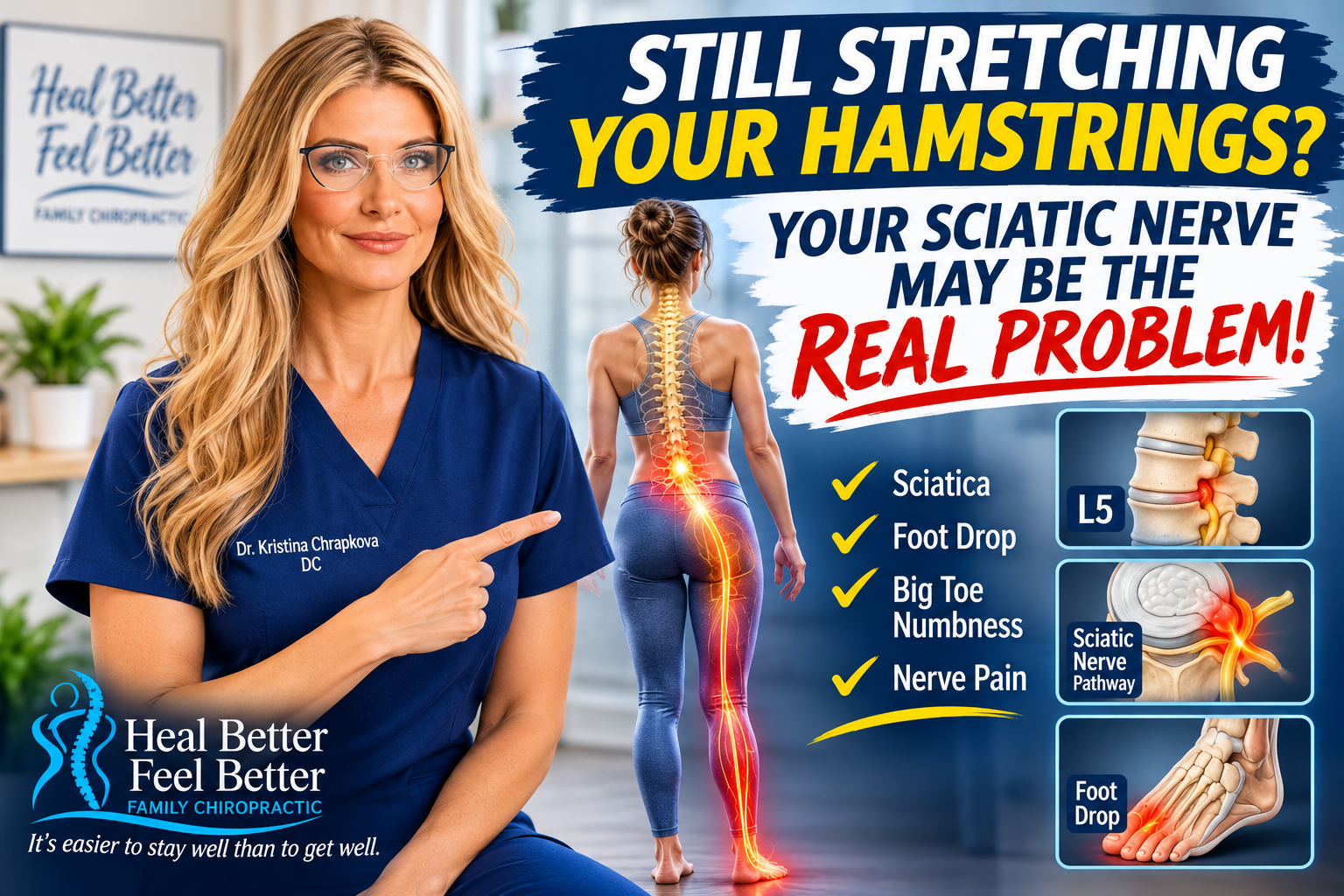
An L4-L5 disc herniation, for example, can affect the L5 nerve root.
Prolonged sitting may increase symptoms in some people, causing pain that travels from the lower back or buttock down the leg.
2. Piriformis-Related Sciatic Nerve Irritation (Deep Buttock)
The piriformis is a small muscle located deep in your buttock, near the sciatic nerve.
When this area becomes irritated, it can contribute to pain that travels down the leg. Sitting for extended periods may aggravate these symptoms, particularly when pressure is placed on the buttock.
Both conditions can produce surprisingly similar symptoms, making it important to identify where the nerve irritation is actually originating.
WHAT DOES THE L5 NERVE HAVE TO DO WITH YOUR FOOT?
Your nerves are responsible for transmitting signals between your brain, spinal cord, and muscles.
The L5 nerve root plays an important role in controlling certain movements and providing sensation in your lower leg and foot.
When the L5 nerve root becomes compressed or irritated, you may experience:
- Radiating pain: Discomfort traveling from your buttock down the back or outside of your leg.
- Numbness or tingling: Particularly around the top of your foot or near your big toe.
- Muscle weakness: Difficulty lifting your big toe or pulling the front of your foot upward.
One symptom you should never ignore is FOOT DROP.
WHAT IS FOOT DROP?
Foot drop occurs when you're unable to properly lift the front portion of your foot while walking.
You might notice:
- Your toes catching on the floor.
- Your foot dragging when you walk.
- Having to lift your knee higher than usual to clear your foot.
- Difficulty walking on your heels.
Foot drop can be associated with L5 nerve root compression, including from a lumbar disc herniation.
However, the problem doesn't always originate in the spine. Compression of the peroneal nerve near the outside of the knee can produce similar weakness.
That's why a proper neurological examination is important to determine where the problem is coming from.
New or worsening foot weakness requires prompt medical evaluation.
WHY STRETCHING YOUR HAMSTRINGS MAY NOT BE SOLVING THE PROBLEM
Here's where many people get frustrated.
They stretch their hamstrings every morning, use a foam roller, massage their buttocks, and try different exercises, but the pain keeps returning.
Why?
Because if the underlying problem involves an irritated nerve, simply stretching the surrounding muscles may not address the source.
In some cases, aggressive stretching can actually aggravate nerve-related symptoms.
The key is understanding whether your symptoms are coming from:
- A lumbar disc or irritated nerve root.
- Sciatic nerve irritation in the deep buttock.
- Peripheral nerve compression near the knee.
- Another musculoskeletal condition.
The right treatment approach depends on identifying the underlying cause.
HOW CAN A CHIROPRACTIC EVALUATION HELP?
At Heal Better Feel Better Family Chiropractic, we believe understanding the source of your discomfort is an important first step toward improving how you move and feel.
A comprehensive evaluation may include:
- Postural and spinal assessment.
- Evaluation of lumbar spine mobility.
- Muscle strength testing.
- Sensory testing.
- Neurological screening.
- Orthopedic testing when appropriate.
Depending on the findings, conservative care may include appropriate spinal mobilization or manipulation, soft tissue techniques, therapeutic exercises, and recommendations for modifying activities that aggravate symptoms.
Not every case of sciatica is the same, and treatment should be tailored to the individual.
WHEN SHOULD YOU SEEK MEDICAL ATTENTION?
If you notice new weakness, your foot begins dragging, or your toes are catching when you walk, seek prompt medical evaluation.
IMPORTANT: If back or leg pain is accompanied by new numbness around the groin or saddle area, difficulty urinating, or loss of bladder or bowel control, go to the emergency room immediately. These can be warning signs of cauda equina syndrome, a serious condition requiring emergency assessment.
THE BOTTOM LINE
If your leg pain keeps returning every time you sit, don't automatically assume you have tight hamstrings.
Sometimes, the problem starts in your lower back. Other times, it involves irritation of the sciatic nerve in the buttock or compression of a peripheral nerve.
The important thing is finding out WHY.
Because stretching harder isn't always the answer. Understanding the source of the problem is!
Does your leg pain get worse when you sit? Have you been stretching your hamstrings without getting lasting relief?
Save this article and share it with someone who needs to understand the difference!
---
HEAL BETTER. FEEL BETTER.
Heal Better Feel Better Family Chiropractic
Dr. Kristina Chrapkova, DC
📍 1000 Whitlock Ave NW, Marietta, GA 30064
📞 770-421-1340
🌐 www.healbetterfeelbetter.com
It's easier to stay well than to get well!
Sciatica #FootDrop #HerniatedDisc #L5NerveRoot #NervePain #PiriformisSyndrome #SpineHealth #LowerBackPain #Chiropractic care #MariettaGA #WestCobb
This article is general education, not individual medical advice. For guidance on your own case, book an exam.